PfdLabs started with a narrow, specific goal: give mineral processing engineers a diagram tool with the symbols they actually need — crushers, mills, thickeners, flotation cells. No more drawing a hydrocyclone out of a rectangle and a triangle in draw.io.
But mineral processing is only the first stage of getting metal out of the ground and into a usable product. After the ore is crushed, ground and concentrated, it still has to go through chemical or thermal extraction to recover the metal itself — and increasingly, that metal has to come back around through recycling once its first life is over.
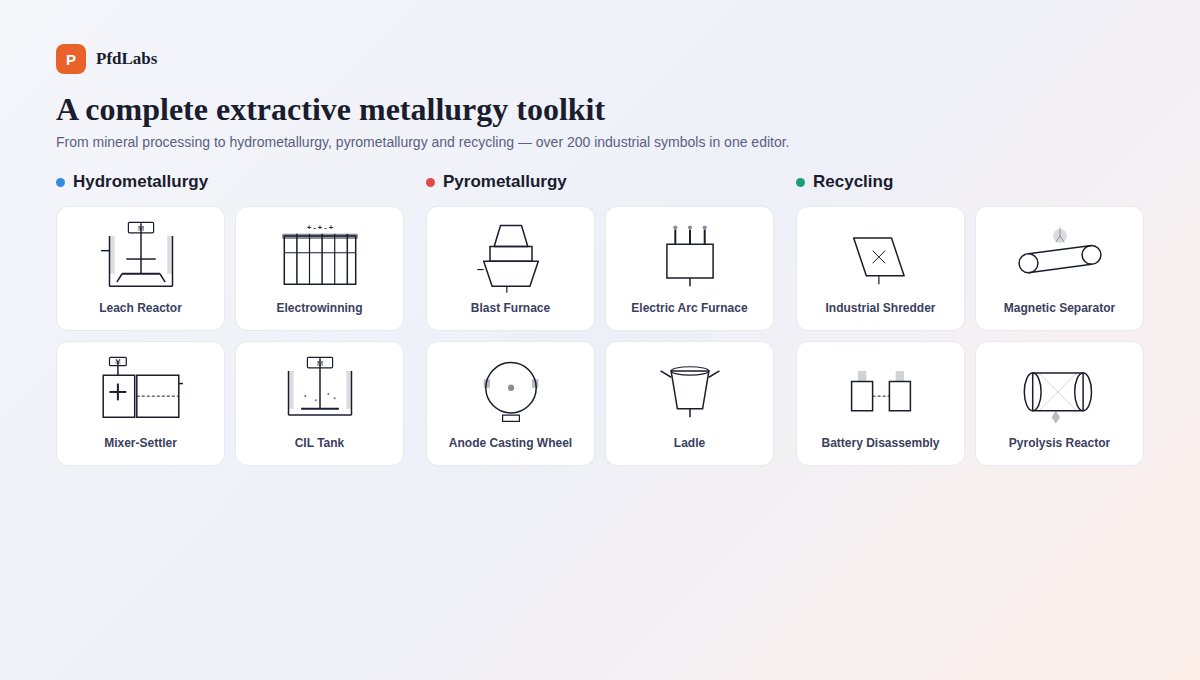
So we're expanding PfdLabs to cover that full chain. Today's release adds over 100 new industrial symbols across three new domains: hydrometallurgy, pyrometallurgy, and recycling.
The three new domains
Hydrometallurgy
- Leaching (heap, vat, pressure, bioleach)
- CIL / CIP gold circuits
- Solvent extraction & ion exchange
- Precipitation & electrowinning
- Reagent & storage tanks
Pyrometallurgy
- Roasting & calcining
- Smelting furnaces
- Converting
- Slag handling
- Refining & casting
- Off-gas treatment
Recycling
- Sorting (magnetic, eddy current, optical)
- Battery recycling
- E-waste processing
- Output & storage
Hydrometallurgy: the aqueous route
Hydrometallurgy covers everything that happens in solution: leaching valuable metals out of ore or concentrate with acid, cyanide or other reagents, then purifying and recovering them through solvent extraction, ion exchange, precipitation or electrowinning. We've added dedicated symbols for the equipment specific to this route — Pachuca tanks, CIL and CIP circuits, elution columns, RIP columns, CIX carousels, and the full SX-EW chain from mixer-settlers through to cathode stripping.
Pyrometallurgy: the thermal route
Where hydrometallurgy uses chemistry in solution, pyrometallurgy uses heat — roasting, smelting and converting ores and concentrates at high temperature to separate metal from waste rock. This was a completely new domain for PfdLabs, and the symbol library now spans the full thermal chain: fluidized bed and flash roasters, flash smelting and electric arc furnaces, Peirce-Smith converters, anode furnaces and casting wheels, right through to the off-gas treatment equipment — baghouses, electrostatic precipitators and acid plants — that keeps a smelter environmentally compliant.
Recycling: closing the loop
The fastest-growing part of this expansion is recycling — battery recycling in particular. As electric vehicle adoption accelerates, recovering lithium, cobalt, nickel and manganese from spent batteries is becoming its own branch of extractive metallurgy, with dedicated unit operations: discharge stations, shredders, black mass storage, and the leaching and separation steps that follow.
"My engineering thesis was on lithium leaching kinetics from spent EV battery black mass — acid leaching of NMC cathode material. Working on that project, I kept noticing how little dedicated diagramming support exists for battery recycling flowsheets compared to traditional mining. That gap is part of why this expansion exists."
Finding your way around
With the symbol library now well over 200 icons, browsing a flat list stopped making sense. The Simplified Symbols panel is reorganized into four top-level areas:
- General Equipment — comminution, classification, separation, transport and storage, shared across every flowsheet type
- Hydrometallurgy — with sub-categories for leaching, CIL/CIP, separation, SX/IX, precipitation and tanks
- Pyrometallurgy — with sub-categories for roasting, smelting, converting, slag, refining and off-gas
- Recycling — with sub-categories for sorting, battery, e-waste and storage
Search works across all four areas at once, so if you already know the equipment name, you don't need to navigate the hierarchy at all — just type and drag.