Circulating load calculator
Calculate the circulating load of a ball mill – hydrocyclone circuit from tonnages, from one size fraction in the cyclone streams, or from % solids.
Percent of one size class, e.g. % +106 µm or % −75 µm, measured in each stream.
% solids by mass in each stream (from a Marcy scale or dried samples).
Closed ball mill – cyclone circuit at steady state: cyclone overflow equals the new feed, underflow returns to the mill.
What is circulating load?
In a closed grinding circuit the classifier — usually a hydrocyclone cluster — sends coarse particles back to the mill. The circulating load is the recycled tonnage expressed as a percentage of the new feed:
Typical ball mill circuits run between 150 % and 350 %. Too low and the mill overgrinds and loses capacity; too high and the cyclones and pumps overload.
Because the underflow is rarely weighed, CL is usually calculated from samples. A balance on any component that is not created or destroyed in the cyclone gives:
water (dilution R = (100 − %S) / %S):
CLR = (Ro − Rf) / (Rf − Ru)
Worked example
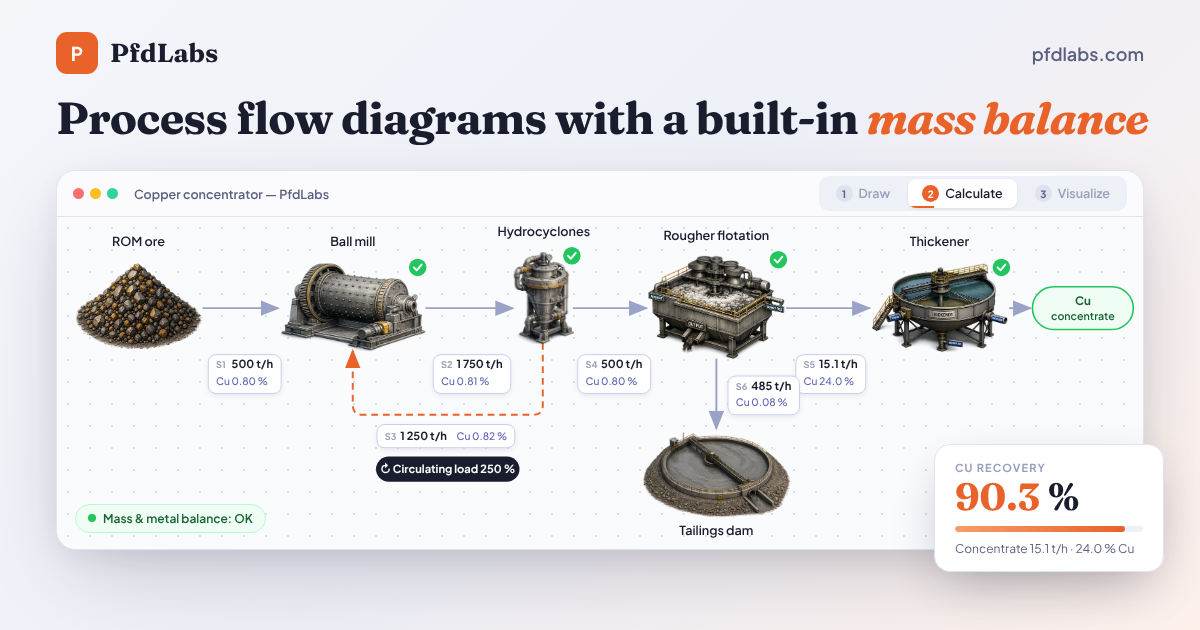
Cyclone sampling gives % +106 µm of 42.0 % in the feed, 8.0 % in the overflow and 55.6 % in the underflow. New feed is 500 t/h.
| Quantity | Calculation | Result |
|---|---|---|
| Circulating load ratio | (42.0 − 8.0) / (55.6 − 42.0) | 2.50 |
| Circulating load | 2.50 × 100 % | 250 % |
| Cyclone underflow | 2.50 × 500 | 1 250 t/h |
| Cyclone feed | 500 + 1 250 | 1 750 t/h |
Tips for reliable results
- Use the size class with the largest difference between overflow and underflow; classes near the cut size give unstable answers.
- Calculate CL from several size classes and from water: if they disagree, a sample is biased.
- The water method needs no sieving, but water added at the cyclone feed sump must be accounted for separately.
Do it for the whole flowsheet
PfdLabs finds recycle streams in your flowsheet automatically and shows the circulating load of every loop on the diagram — together with the full mass, water and metal balance.
Frequently asked questions
What is a normal circulating load in a ball mill circuit?
Most closed ball mill – hydrocyclone circuits operate between about 150 % and 350 % circulating load, with 250 % a common design value. The optimum depends on the classification efficiency and the mill.
How do you calculate circulating load from a size analysis?
Measure the percentage of one size class in the cyclone feed (f), overflow (o) and underflow (u). The circulating load ratio is (f − o)/(u − f); multiply by 100 for percent.
Can circulating load be calculated from % solids?
Yes. Convert % solids to dilution ratios R = (100 − %S)/%S for feed, overflow and underflow, then CLR = (Ro − Rf)/(Rf − Ru). This assumes no water is added between the sampling points.
What is the difference between circulating load and circulating load ratio?
The circulating load ratio is the underflow tonnage divided by the new feed (e.g. 2.5). Circulating load is the same number expressed as a percentage (250 %).
More free tools
Two-product formula calculator
Mass yield, recovery and enrichment ratio from feed, concentrate and tailings grades.
Circulating load calculator
Grinding circuit circulating load from tonnages, a size fraction or % solids.
Pulp density & % solids calculator
Slurry density, % solids by mass and volume, water and slurry flow.